
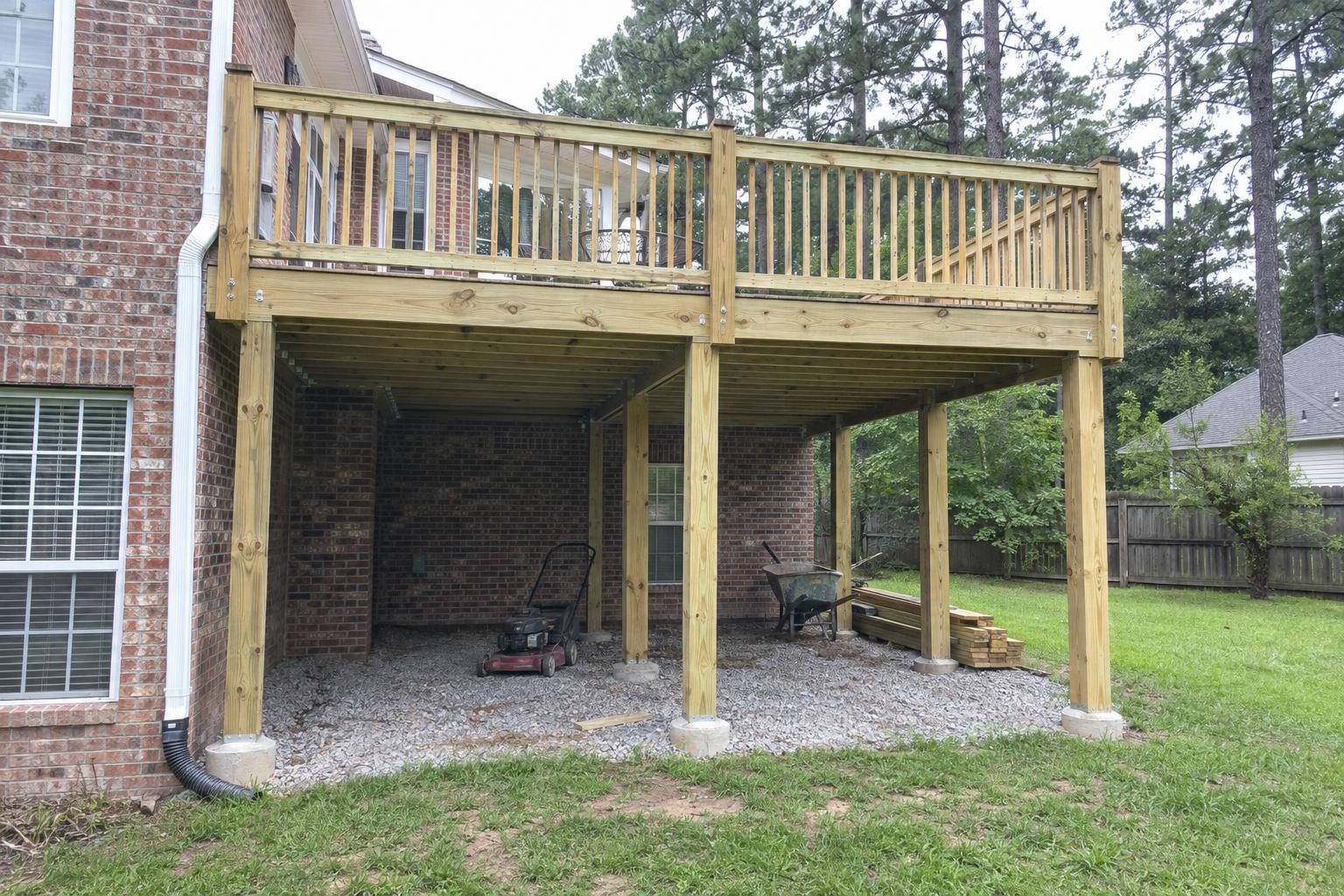
Picking a deck builder in Pascagoula isn't like picking one in Nashville or Atlanta. The ground here is different, the air is different, and the storm season is long. A contractor who's never built on the coast will make mistakes you don't see until year three, when the posts start to shift or the hardware starts to bleed rust down the boards. Here's what actually separates a builder worth hiring from one you'll be calling back to fix his own work.
Start with what's under the deck, not what's on top of it
Most of Pascagoula sits on sandy, loose soil with a water table that can be only a few feet down, especially closer to the river or the bayous. Sand drains fast, which sounds like a good thing, but it also means a footing that isn't deep enough or wide enough can settle unevenly after a few wet seasons. Ask how deep the footings will go. Around here that's typically 24 to 36 inches, below any fill dirt, landing on undisturbed soil. If a bidder gives you a number without asking about your soil or your drainage, he hasn't thought about it.
Low spots matter too. If your yard holds water after a heavy rain, that's information a builder should use to decide where posts land and how the deck pitches away from the house. A deck that traps standing water under it will rot its own framing from below, where you can't see it until the boards start to bounce.
Permits aren't a formality, and skipping them should be a dealbreaker
Deck work in Pascagoula and the surrounding parts of Jackson County generally needs a permit, and for good reason. An inspector will typically want to look at the footings before they're covered, and the framing and ledger attachment before the decking goes down. If you're near the water or in a flood zone, there can also be questions about elevation and setback from the property line that get checked against your survey. A builder who tells you permits are a waste of time, or that he'll just do the work quietly to save you money, is telling you he's done this before without getting caught. That's not a reference, that's a warning.
HOAs aren't universal here the way they are in some newer coastal markets, but they do exist in some of the newer subdivisions out toward Gautier and Ocean Springs. If you're in one, your deck size, railing style, and even stain color might need approval before a permit gets pulled. A builder who's worked in your neighborhood before will know this without you having to explain it.
The hardware matters more here than almost anywhere inland
Salt air corrodes standard galvanized fasteners faster than people expect, sometimes within a handful of years this close to the Gulf. Ask specifically what nails, screws, and joist hangers are going into your deck. Hot-dipped galvanized rated for ground contact is the minimum. Stainless steel costs more but holds up longer, and on a ledger board or a post base, that's not the place to save a few dollars.
The ledger board, where the deck bolts into your house, is the single most common failure point in deck construction anywhere, and it's worse in a humid climate. It needs proper flashing to keep water from wicking into the house framing behind it. If a builder can't explain how he's flashing that connection, ask someone else.
Pressure-treated lumber grade matters too. Framing should be rated for ground contact if it's within 6 inches of the soil or sitting in standing water after a storm, not the lighter above-ground rating some builders use everywhere to save money.
Wood or composite, and why the choice is different on the coast
Composite decking has gotten better over the years, and it doesn't rot or need re-staining. It does get hot. Dark-colored composite in full Gulf Coast sun in July can get hot enough that bare feet won't thank you, something worth asking about if you've got kids or you plan to use the deck most of the day. Pressure-treated pine is cheaper up front and handles heat fine, but it needs staining and sealing on a real schedule here, roughly every two to three years, because the combination of UV and humidity breaks down an unsealed finish faster than it would somewhere drier.
If you're staining or sealing after installation, ask when they plan to do it. New pressure-treated lumber needs to dry out first, sometimes 60 to 90 days depending on how wet it was when it was milled, before a sealer will actually soak in instead of sitting on the surface.
What to walk away from
- A quote with no mention of footing depth, fastener type, or flashing. If it's all square footage and no detail, it was written fast and it'll be built fast.
- Anyone who tells you a permit isn't needed for your project. Ask the city or county yourself if you're not sure.
- A price that's dramatically lower than two others for the same square footage and materials. Something's getting skipped, and it's usually underground where you won't see it.
- No proof of insurance. A fall off a deck under construction, or a mistake that damages your house siding, is expensive, and you don't want that bill landing on you.
- A builder who can't show you a deck he's built that's at least a few years old. New work always looks good. Weathered work tells the truth.
A short written contract is worth more than a verbal promise, even a sincere one. It should spell out materials, fastener type, footing depth, start date, and a rough timeline. A single-level deck of normal size usually runs a few weeks from permit to finish, longer if it's multi-level or screened in. If someone promises it in two days, ask what's being skipped to get there.
If you want to talk through your yard, your soil, and what it would take to do this right the first time, Bridgewood Deck Contractors builds decks up and down the Pascagoula area and can walk the site with you before you spend a dollar.